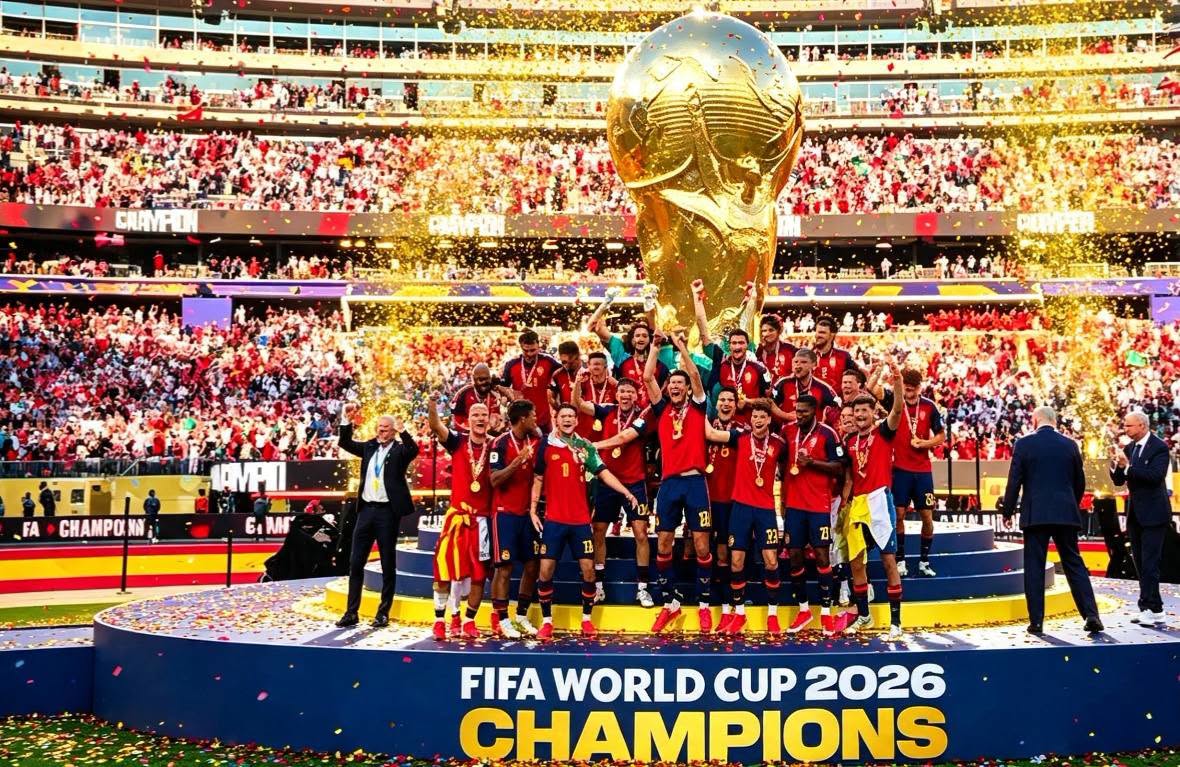
Spain are world champions: here are my five takeaways from the FIFA World Cup 2026 final
-
 Haileegziabher Adhanom
- 2 Min To Read
- 19 Jul, 2026

Ferran Torres #7 of Spain celebrates scoring his team’s first goal during the FIFA World Cup 2026 Final match against Argentina at New York New Jersey Stadium on July 19, 2026. (Photo by David Ramos/Getty Images)
NEW YORK/NEW JERSEY - July 19, 2026 Spain won their second World Cup title after 16 years, dethroning defending champions Argentina in one of the most lopsided FIFA World Cup finals in recent memory. Ferran Torres scored the only goal of the match, in the first minute of the second half of extra time.
Spain had a very strong and positive start to the game. The usual ball possession dominance was theirs. 64% in the first half and they also created decent chances in the process: Lamine Yamal's low shot, following a blocked effort that nearly turned into an own goal off Lisandro Martinez, was saved by Emiliano Martinez.
After the water break there were further moderate chances for Spain, this time from Mikel Oyarzabal and Marc Cucurella. Despite a good spell of play, the effort didn't bring any reward for the European champions.
The defending champions finished the first half on the back foot, and their game plan appeared built around holding their organisation, sitting deep, and not conceding. There was no sign of attacking intent from them. It looked as though they were saving themselves for a late attack, as has been their pattern throughout the tournament. However, it never came. Finished the whole 120’ of the game without a single on target attempt.
Both teams made multiple changes in search of control in the second half, but it was only the Spanish show, as a Messi led Argentina failed to produce any spark. The second half looked like a mere continuation of the first, with Spain adding more directness to their play and creating chance after chance without converting. Partly they weren't clinical; partly, the ever present Martinez was in superb form throughout, making a record breaking 11 saves in the final match. He was also commanding, controlling the tempo, and launching attacking transitions with long passes.
But, things went from bad to worse when, semifinal hero Enzo Fernandez was sent off in stoppage time of regular time, shown a second yellow card after committing a foul on Pau Cubarsi, following a reaction to a refereeing decision that had earned him his first yellow moments earlier. Argentina was forced to play the final 30 minutes with a man down and completely lost their grip on the game. Down to ten men, and down in morale and emotion, they conceded in the final 15 minutes of extra time, extinguishing any hope of taking the match to penalties and trying their luck as they had four years earlier in Qatar.
Here are my five take aways from the final:
Team over individual brilliance
We have seen time and again that a moment of individual brilliance decides the outcome of a match, in this World Cup or elsewhere. But Spain’s victory over Argentina reminds us all that football remains a team sport.
For far too long, Lionel Messi carried this national team to its glories or perhaps the team overrelied on his magic. However, overcoming a team as solid and strong as Spain requires more than individual brilliance, even if you are Lionel Messi, with unbelievable talent and an amazing run of form, contributing 12 goals and assists in the tournament.
In fact, Spain’s strength, as many have agreed, emerges from their collectiveness and unity, both with and without the ball, rather than overrelying on one superstar like their counterparts. This total annihilation of Argentina on the biggest stage in world football proves that no matter how good you are individually, if your opponent is playing as a unit and you fail to match that, the results are clear.
Spain showed what can be achieved when a team plays with a distinctive identity and dominant performance throughout the tournament. To be fair, it wasn’t only Argentina who tried to stop them, France and Portugal did too, and both failed.
Spain, the most successful national team of the 21st century?
There have been eras dominated by different national teams, either for their playing styles or for their successive victories on the global stage. There were the Brazilian, Dutch, German, Hungarian eras, and so on.
But this quarter of the century is simply Spain’s era. not only for their wins, but for how they are winning. Three European Championships and two World Cups, the Nations League, the Olympics, every youth championship, and the Women’s World Cup since the turn of the century, not to mention how their elite clubs and managers are doing in world football. It’s without a doubt the Spanish era.
France and Argentina are the closest. Germany and England are also doing great, but what distinguishes this Spain team is that they are serial winners. They may fall short at times as they did in their 2014 title defence, again in 2018 and 2022. but once they get a sniff of victory and reach the finals, they know how to win it. Considering how youthful and talented this team and its structure are, Spain’s dominance of global football looks set to continue.
Argentina lose on and off the pitch
Forget about the allegations of favouritism towards the Argentina national team throughout the tournament. Or the racism attack being investigated by FIFA, allegedly directed at global content creator IShowSpeed by their fans. Or the politicisation of their semifinal victory over England, via a banner hoisted with a controversial message regarding the Falklands (Malvinas) Islands. Or the dark arts their players have been accused of. Or Lionel Messi’s uncharacteristically unsportsmanlike appeal for the referee to send off Marc Cucurella for covering his mouth in a confrontational manner, etc.
But what transpired right after the final whistle was purely classless. Argentina weren’t just losing the match, but, the conduct their players showed after the final whistle was way out of line, unprofessional, and will carry consequences.
The actions of Leandro Paredes and several other players and members of the Argentina coaching staff were disgraceful for the beautiful game. And when the deserved eventual winners were handed the trophy, all the Argentina players turned their backs, facing their own fans instead. Failing to applaud the champions was another unfathomable piece of behaviour from such elite players and one of the game’s great footballing nations.
The First Ever Halftime Show
What makes the 2026 Fifa world cup is that it’s the world cup of many firsts, 48 teams, three host nations, hydration breaks, champions ring, huge turnouts and the most profitable and the list might goes on…and among the firsts was the Super Bowl esque half time show.
The game was preceded by performances from Tom Cruise and Robbie Williams, and Jennifer Hudson sang the USA national anthem. But as many say the Americanisation of football was completed with the introduction of an extended, 25 minutes half time show, featuring celebrated singers and global icons such as Madonna, Shakira, Justin Bieber, and BTS, performing for the 82,000 seat, full house crowd at the New York/New Jersey stadium.
Reaction among fans appeared divided, some enjoyed the extra entertainment segment, while football purists seemed to dislike it and voiced their disapproval.
Individual Awards
Spain’s dominance throughout the tournament, especially in its latter stages of the tournament brought them not only the most important team victory and a second star on their shirt, but individual accolades as well.
Just moments before the trophy presentation, FIFA’s Technical Study Group recognised four Spanish players as the tournament’s outstanding performers.
Golden Ball - Rodri -Spain
Man of the Final Match - Ferran Torres - Spain
Golden Glove - Unai Simon - Spain (7 clean sheets, one goal conceded)
Best Young Player of the Tournament - Pau Cubarsi - Spain
Golden Boot - Kylian Mbappe - France (10 goals) all time World Cup top scorer with 22 goals.
Most Assists - Michael Olise - France (7 assists)